Posts

The golem

Image
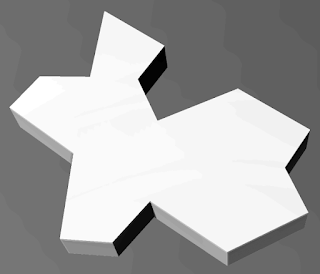
This shape which I have named the golem, was hand picked from hundreds of Spectre-like polygons (Spectroids) that were sent my way via Ortwin Schenker, Bob Nungester and Bram Cohen.   This golem has the same number of sides as the Spectre and also shares internal angles of 90, 120 and 270 degrees. Below left is the simplest of the periodic tilings.  Positioning of new tiles is forced in most cases.  That said, the pattern can deviate at any time by placing other rotations where there are choices (as shown in the example bottom right). The golem is a delight to tessellate (you can't go wrong!).  Below are a few more examples of periodic tilings.  These can be sewn together to make larger chaotic tilings with a bit of tweaking. Next up are a couple of radial patterns.  The example on the right is (I think) quite unusual in that three golem segments are pointing towards the centre whilst the other three are pointing outwards. The golem has mirror symmetry...

Determining chess 960 starting positions with a standard die (no rethrows)

Image
Chess 960 is a chess game variant invented by Bobby Fischer in 1996.   In Chess 960, the pawns are lined up on the second rank as in standard chess.   The first rank pieces are positioned randomly whilst conforming to certain caveats - the king must be placed somewhere between the rooks to allow castling; the bishops must stand on opposite coloured squares. I've worked out a system that allows me to select a starting arrangement for the first rank pieces using a standard six sided die without the need for rethrows.  My dice procedure is different from that of  I ngo Althöfer's (devised in 1998), where rethrows can occur.   Some information on how his system works can be seen here https://www.chessvariants.org/diffsetup.dir/fischer-random-setup.html The die I use to generate the random piece arrangement is a standard cube/hexahedron (one of the platonic solids).  O nly five or six throws of the die are needed to formulate one of the 960 ...

Pseudo Islamic art-like patterns

Image
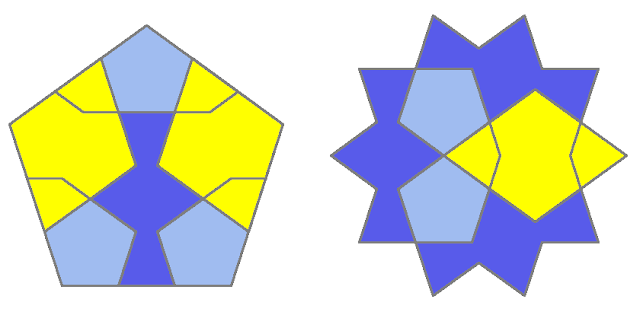
Three shapes, the b owtie, regular pentagon and rhombus (with markings)  are all that are needed to produce Islamic art-like patterns.   The large regular pentagon (on left) contains  three  smaller pentagons,  two  rhombi and one  bowtie. Ten pointed star (on right) is made up of  three  bowties,  two  regular pentagons and  one  rhombus. Ten rotations of each... Here's the sort of thing you can do... The batman below comprises  two regular pentagons,  one  rhombus and one bowtie. Below - one example (plain/decorative) of a periodic batman pattern and another including rhombi.

Nine kites

Image
All permutations of polykites from 1-24 have been exhaustively researched by Joseph Myers.  His computational results almost run into trillions.  For more info, please visit - https://www.polyomino.org.uk/mathematics/polyform-tiling/ I have already covered a few polykites (including the hat and turtle) and have now picked out another that has an interesting property.  This polygon has sixteen sides and I have named it the 'hare'.  It also resembles a bushy tailed squirrel but I already have accounted for two of them - https://hedraweb.wordpress.com/2022/10/14/polydrafter-squirrels/ It tiles periodically with or without reflections Hares can be assembled to make up triangles of unlimited size.  The hexagon on the right is made up of six of the smallest triangles. Smallest hexagon inside a large triangle.   The triangular area above can also be assembled in at least one other way.  I flipped it to suit.   Below is a larger hexagon made up ...

Fractal chevron

Image
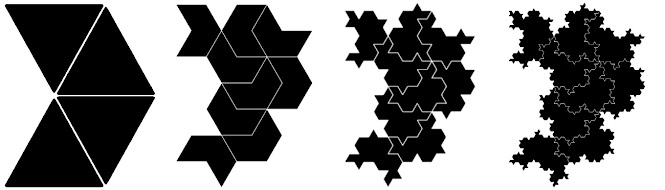
I started with a chevron consisting of four equilateral triangles.  Each of those was then subdivided into nine smaller triangles, so that alternating bumps and notches could be applied to the centre of each side on the perimeter (for practical reasons I used a reverse approach, scaling up sides by a factor of three and reducing once done).  In theory, this process can continue indefinitely to produce complex fractal-like outlines.     There are left and right versions of the modified chevron, depending on which face is upward.  This means you cannot use both versions in the same tessellation.  Nine copies of each newly generated tile, can be put together to produce the next iteration.  Applying bumps and notches to even numbered polyiamonds, alters the tiling properties after the first iteration. There are four permutations for the chevron but only two for the modified versions, i.e., first and third from the left. These bumped and notched chevro...

Kite and dart from a square - revisited

Image
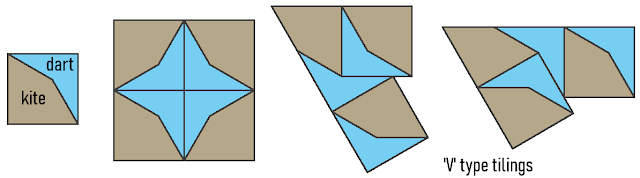
Here's the link to the first part... https://hedraweb.wordpress.com/2018/02/06/not-so-square/ I have found more (subtle) combinations of how a kite and dart from a square can be assembled.  Tilings will usually include a mix of square blocks, rows/columns of squares and ever expanding 60° areas, emanating from a single point which I describe as 'V' type tilings.  So, with that in mind here's some bare bones examples, A line of darts touching darts head to toe produce zig-zags, creating offsets (rivers).  Same with kites. Left, an interesting arrangement where 'V' type tilings don't quite touch each other at the centre.  Right, an attractive 4-fold symmetry. Two kites can be put together with another type of dart that produces equilateral triangles and in turn, regular hexagons. Not surprisingly, combining both types of darts and kites make up a regular dodecagon.